I was a little nervous as the masses of teenage girls poured into the doors of the school gymnasium and squeezed into chairs facing all 5 women who work at the Angoche Secondary School. My pedagogical director gave a brief introduction to the girls siting the huge female drop out rate and 53 pregnancies as the motivation for the assembly. And then she turned the floor over to me. I was shakin at first feeling a little overwhelmed by the weighty and uncomfortable topic as well as the number of older students-many of whom are not that much younger than me. But finally settled into a normal rhythm of a biology lesson. They were so receptive. We went over male anatomy and female anatomy and physiology focusing on the menstruation cycle and how pregnancies occur. I was amazed at the lack of information they have about how their bodies work and how to take care of themselves. By the time I got through the technical info and responded to questions, we had already been there for 90 minutes. I was glad to have my colleagues there. In any given language there's practically a whole dialect of slang devoted to sex practices and reproductive organs. Add to that the confusion with terms in Koti and Macua, both local languages, stir in Islamic practices as well as initiation rites ceremonies I still don't understand, sprinkle the cultural differences between Western and African thinking on top and you've got a nice big dish of confusion. But as a team, we worked pretty well. It was fun and interesting to be a part of it with them, realizing that no matter how different our lives are, there is still so much that women have in common. duh. Sorry this is getting really corny. But seriously. It was good.
Anyway, after I fielded a lot of questions on technical topics, my loudest, sassiest colleague got up in front of the girls and threw out some extremely controversial statements inciting a uproarious debate. I definitely became a spectator. I'm usually not a fan of this type of teaching method. It gets a little too emotional and dramatic for me. But it worked. I learned a lot.
My colleague got her spicy sista attitude on and asked the girls why they go after old men who've lost their taste.
The first girl stood up and delivered a rather sermon-like seemingly practiced speech citing behaviors that girls commonly use to go after a male teacher. She ended with a dramatic "it's us who go after them!"
My jaw dropped.
Half the girls in the room clapped or hooted or nodded in agreement.
The other half of the girls were livid.
Another girl in tears stood up and disagreed. She shared that when she was 14, an older, disgusting teacher had approached her. "What would I ever want with a gross old man when I'm 14?" She yelled. They come after us and if you reject them, you might not pass. Who wants to flunk?
A couple other girls stood up and shared and then my colleague asked them what the motives are for those girls who approach teachers. There were a lot of motives mentioned, but from what I gather these were the main motives stated by the girls themselves:
1. Their parents push it in effort to get one more child out of the house and into the house of someone who has constant work.
2. The girls like the teachers. Many of them aren't really all that much younger than some of the younger teachers.
3. They want money or new clothes and a cell phone. One girl actually stood up and said she didn't think anyone in the room would reject a proposition for 1,000 mets (roughly $28). Most in the room agreed.
4. They want to pass. And if they have sex with a teacher, that teacher then makes sure that their colleagues pass the girl in every discipline.
At this point I was feeling pretty sick. It seems my colleagues were right on a number of points about the girls provoking the teachers. I couldn't believe what some of the girls were openly admitting to.
Even so...
I still want to castrate some of my male colleagues. They are adults (many married) and a kid is a kid. The lines get so blurred here.
I was wondering how these points were all going to be addressed.
My colleague leading this debate finally responded and had a number of intense retorts about the girls' embarrassing behaviors--for those provoking situations. She talked to them about having a little big more dignity not in their sexuality but in their ability to study and do something better. She also said how disgusted she was with them because a lot of them were making women in general look bad when they are too lazy to study so just have sex to pass. Another colleague talked about how many more opportunities they have than she did just one generation ago, and if they just get through high school and maybe collage, life for them would be considerably better.
She also addressed how to avoid becoming a victim. The girls were told never to be flirty, to concentrate on studying, to be serious and determined, and to save everything for their records in case some situation would ever come up. "And if one ever does approach you--my colleague advised-- you look him straight in the face and tell him, I mean no disrespect, but I want the same opportunities to study that you had, teacher, without having to deal with the funny business!"
Wowza.
I was a bit naive, thinking the girls were always victims with no control.
I have such a refreshed respect for my female colleagues.
And I'm mad that there isn't much more that can be done about the situation.
I can't imagine what it must be like to be them. I grew up in such a different environment. Going to school and having to worry about that kind of stuff? Yikes.
Sunday, October 10, 2010

Saturday, October 9, 2010
Scandalous
I sometimes struggle with what to write and not to write on my blog. I love so many things about Mozambique and Angoche in particular. I don't like writing negatively; especially since you all can’t see the whole for yourselves. But corruption in the school is such a huge issue in my life here.
Last Friday I was informed of a meeting only for the female teachers at our high school. Oh boy, what is this about? Except for the remote possibility of my female colleagues wanting to go on a girls’ night out shopping for capulanas, I was dreading the reasons for calling together the 5 total women who work in the secondary school system here in Angoche. It’s going to be something about our girls. I wondered what had happened and what they expected us to do about it. Many of the problems women experience here are because of men, so why don’t they get called into a meeting?
A few days before the meeting, I was talking to one of my male colleagues who I respect and trust the most. I told him about the meeting and asked him what it was going to be about. He said it would be about pregnancy. I asked him why alllll the teachers weren’t invited since many of them like to chase after the girls. “Mana” (or sister), he said, the girls are the ones who provoke teachers!” After sitting through a tearful meeting just a week ago with our cream-of-the-crop students in our girls’ group listening to them tell their stories of male teachers in our school who have taken “special interest” in them and all the trouble that ensues when girls are noticed by a teacher. Hearing their stories about this particular hardship frustrates me more than anything here. I was not happy with his response and let him know it. He told me I thought that way because the girls I spend most of my time with are the good girls. He started to share what it’s like to be a male teacher in Angoche, who is one of the few teachers who reportedly does not “conquistar” (literally conquer, but it this case means seduce) female students. He said one day he had a discussion with a female student about why she didn’t have a notebook. The student said she had no money. He asked her why she had a beautiful, expensive looking weave if she had no money for notebooks. She responded with a rather spicy “so teacher will notice me.” He also told me about the dramatic letters he intercepts sometimes as a director of turma, the US equivalent of a homeroom teacher. He said that so many girls pursue teachers so aggressively that they even fight each other over certain teachers. He offered to show me the letters if I wanted proof. Not a native to Angoche, he also enlightened me about what he was told when he was transferred here. He was repeatedly informed that he would certainly forget the fiancé he was leaving behind in his home city if he came to work in Angoche because women from Nampula (our province) are so beautiful. I’ve certainly heard that before about women in this province, but always thought of it on a much more innocent level. He asked me if I thought women here were remarkably more beautiful than in the south.
Not really.
Then why do you think the women here are legendarily beautiful to the point that people all the way down in Southern Mozambique talk about it?
I don’t know.
Do you know what they do at initiation rites ceremonies, Mana? At the first sign of menstruation for the girls, they hold the ceremony, explain to the kid she’s an adult now, instruct her on the mechanics of sex, and often fail to also impart guidelines about when and with who these activities should be done. In fact, most parents, he shared, are the ones who push the girls into relationships in order to get one more mouth to feed out of the house. And that, he concluded, is why women from Nampula are more “beautiful.”
Great, I live in the middle of a culture which breeds easy targets and labels them beautiful for it. Does my little girls’ empowerment group stand a chance? My colleague certainly made a number of good points, but I’m not completely convinced.
Our suspicions about the meeting were confirmed. My pedagogical director, one of the 5 women in the school, sat us down in her office and announced that female enrolment was down by 200 students since 2006 and that 53 girls are pregnant in our school and those are just the ones who were big enough to start showing and they hadn’t done a sweep of the 8th grade classes yet. I’ve gotten to watch this process before and every time it horrifies me. A girl walks past a teacher. The teacher suspects they might be pregnant and calls the girl over. The teacher asks “what is this?” “do you have a belly?” or “is there a package in here?” while rubbing the girls’ stomach to see for themselves. This usually happens wherever and in front of whoever happens to be around. If the student is not pregnant, she giggles, and tells the teacher she’s just getting fatter. The girl usually starts crying if she is pregnant and is told to report to the office to transfer to night school. Night school is not taken seriously here. It’s full of last-chance older kids who couldn’t behave during day school and adults who are trying to get their high school degree because during their youth, the civil war was raging, making studying impossible. They don’t care much about learning, they are just there to get the piece of paper that says they passed 12th grade. Usually when these young pregnant girls go to night school, they quit studying.
My pedagogical director asked us what we were going to do about all the pregnancies.
Silence.
I decided to be a little more bold than I usually am with my colleagues and asked them what why all of our male colleagues were excluded from the meeting when they are certainly responsible for at least a portion of the 53 pregnancies. Eyes widened. “Really?” they asked, apparently unaware of the possibility.
Seriously??? I thought. Come on. Are you blind? Don’t try to tell me you don’t see this. Our colleagues ride around with the girls on the backs of their motorcycles and disappear into houses together. These girls who don’t have any money mysteriously start wearing beautiful clothes. Some colleagues have even openly admitted to me that they have sex with students. How do the girls have a chance if they reject a teacher? Teachers have power and money and connections. My director interrupted me and with a tired face, told me that in all reality, there’s more to they story than I know. The girls provoke them.
Here we go again, blaming the girls.
And besides that, she went on, there’s not much they can do to stop the male teachers’ behavior in this area. So she posed the question again. What are we going to do about it?
I was fantasizing about castration in my head but together we decided the best option would be an assembly of sorts with just the girls to go over some information they are no doubt lacking, to hear their perspective on all of the inappropriate relationships, and try to encourage them to continue studying. As the resident anatomy teacher, I have the pleasure of teaching reproductive anatomy and birth control methods during this assembly for half of the female students in the public school system. How’s that for pressure? It’s ridiculous that I could be the most qualified person to do this. Poor girls. Anyway, I am pretty impressed right now with my female colleagues…we met, didn’t waste time, decided what we wanted to do, wrote a plan, and dismissed. I almost felt American. It’s amazing how different women are when men aren’t around. Anyway…stay tuned to hear about the sex assembly.
Happy Birthday Angoche
Para bens Angoche! On the 26th of September my beautiful little city turned 40 years old. Angoche Day happens to land on the calendar right next to Armed Forces Day, so we had 2 weekend holidays which in Mozambique translates to no work/school on Friday or Monday. Party on!
This year's festivities were much like last year's. Lots of struttin around in Angoche Day capulanas, traditional singing and dancing, drinking, going to the beach, live concerts, dances, eating, and of course, all of the competitions. Every year, there is a men's and women's foot race, a bicycle race, a needle-threading race, a water jug on the head race, and the most exciting of all, a motorcycle race! Just like last year, Angoche turned into a bustling city as everyone from the bairos, and outskirts come in to walk around and participate in events. And no one misses the motorcycle race. It seems insanely dangerous to me especially when a girl comes from a land where helmets, seat belts, speed limits, baby seats, warning signs, and guard rails are the norm; and there was actually one casualty this year. But hey! I guess this is what people do when they're hard up for entertainment.
 David, Melissa, and Gina all came in to celebrate Angoche Day with me and my lovely site mate Margarida. We were fortunate enough to watch the race comfortably from the balcony of Fabiao's apartment on main street.
 People will do anything to get a good view of all the Evel Knievel wanna-be's.
 And I mean anything. In fact, this roof got so crowded, someone fell off the top. The ambulance following the cyclists had to make a stop to pick him up.
 And here's the excited crowd rushing toward the winner of the motorcycle race. Turns out, it was one of my colleagues who teaches 8th grade math. Represent
 Mozambican enthusiasm may have been for the motorcycles, but for the Americanas, the men's run was the focus. Last year when I watched the men's 10K race, I knew I wanted to participate the next year. Most of the participants couldn't even finish partly because they sprint the first lap like they're runnin a 100M dash and then die and partly because the concept of working really hard and training well is a bit fuzzy. To many Angocheans, training means taking a little jog and doing some weird hip-thrusting calisthenics the night before a race. When one can't finish a race, he either runs straight of the course to hide somewhere or he flops himself on the ground dramatically. It's pretty great. The women's race is only 2K, which is a pretty big insult in my opinion.
So anyway, I wanted to participate this year, thinking it would be a really great girl power example to Angoche. When I asked to sign up myself and 3 other female colleagues for the men's race, guys laughed in my face, which inspired me all the more. I was surprised that even Mussa, one of our best, open-minded friends had to be threatened to sign us up with the organizing commission. Whenever ppl heard about it, we got amused but negative responses. Even our Papa Fabiao at the post office who knows us so well and sees us running all the time told me that I certainly wouldn't be able to do it, even though most days I run 12K or more.
In fact the only Mozambican man who was fully supporting us and even bragging to everyone that we were going to win, was our wiry, slightly crazy, old guard. Feliciano even agreed to be our water boy on race day cause he wanted to be there when we crossed the finish line.
So anyway, the day of the race came and they tried until the last minute to get us to participate with the women. I had to throw a fit in front of the Mayor of Angoche before my request was observed. As they were stapling our numbers to our shirts and telling us we were going to die and I thought it might be a real possibility now that things had run so late. The race was scheduled for 7:30AM. We actually go on the line at 11:30. It was toasty and super sunny and there is no shade; but the Americanas made a great showing. Once they saw after the first sprinted lap that we weren't going to die off so quickly, people were a little more supportive. In fact, some students were so concerned about how much Senhora Professora was sweating and turning red, that I was dowsed with water 3 times.
 Melissa ended up coming in 3rd, I got something like 6th, Gina and Margarida placed somewhere after that. We can't be too sure. They lost count of both people and laps. Whatever. I thought the point had been made. We beat a good number of the guys and actually finished the race as opposed to a third of the male participants who walked after the first 2 laps or disappeared into the crowds.
 This is the Moz way to take a pic--no smiling, and ya gotta have a prop.
 And there he is, our waterboy/coach/biggest fan. Thanks Feliciano.
 I wish I could say that running the race proved all the naysayers wrong. I've gotten mixed reviews. Many people responded so positively, the way I had hoped. "Wow, I didn't know that was possible, but now I do!" Some men including Fabiao, have continued to laugh at me saying that they were right all along, women can't do it. What the what? Some students and colleagues have asked me why I bothered finishing the race because I only got 6th and that I embarrassed them by not winning.
I didn't win.
But I finished.
And I finished in front of over half the men who were actually able to finish.
Epa.
I guess generations of particular ways of thinking far outweigh one 10K race. And although I "embarrassed" a lot of people, we were the talk of the town as everyone was at least excited to see 4 white women runnin with the guys. Hopefully more ladies will participate in the future knowing that the opportunity is there. I'm going to mark it down as a win and award myself at least 3,000 integration points.
This year's festivities were much like last year's. Lots of struttin around in Angoche Day capulanas, traditional singing and dancing, drinking, going to the beach, live concerts, dances, eating, and of course, all of the competitions. Every year, there is a men's and women's foot race, a bicycle race, a needle-threading race, a water jug on the head race, and the most exciting of all, a motorcycle race! Just like last year, Angoche turned into a bustling city as everyone from the bairos, and outskirts come in to walk around and participate in events. And no one misses the motorcycle race. It seems insanely dangerous to me especially when a girl comes from a land where helmets, seat belts, speed limits, baby seats, warning signs, and guard rails are the norm; and there was actually one casualty this year. But hey! I guess this is what people do when they're hard up for entertainment.
 David, Melissa, and Gina all came in to celebrate Angoche Day with me and my lovely site mate Margarida. We were fortunate enough to watch the race comfortably from the balcony of Fabiao's apartment on main street.
  People will do anything to get a good view of all the Evel Knievel wanna-be's.
 And I mean anything. In fact, this roof got so crowded, someone fell off the top. The ambulance following the cyclists had to make a stop to pick him up.
 And here's the excited crowd rushing toward the winner of the motorcycle race. Turns out, it was one of my colleagues who teaches 8th grade math. Represent
 Mozambican enthusiasm may have been for the motorcycles, but for the Americanas, the men's run was the focus. Last year when I watched the men's 10K race, I knew I wanted to participate the next year. Most of the participants couldn't even finish partly because they sprint the first lap like they're runnin a 100M dash and then die and partly because the concept of working really hard and training well is a bit fuzzy. To many Angocheans, training means taking a little jog and doing some weird hip-thrusting calisthenics the night before a race. When one can't finish a race, he either runs straight of the course to hide somewhere or he flops himself on the ground dramatically. It's pretty great. The women's race is only 2K, which is a pretty big insult in my opinion.
So anyway, I wanted to participate this year, thinking it would be a really great girl power example to Angoche. When I asked to sign up myself and 3 other female colleagues for the men's race, guys laughed in my face, which inspired me all the more. I was surprised that even Mussa, one of our best, open-minded friends had to be threatened to sign us up with the organizing commission. Whenever ppl heard about it, we got amused but negative responses. Even our Papa Fabiao at the post office who knows us so well and sees us running all the time told me that I certainly wouldn't be able to do it, even though most days I run 12K or more.
In fact the only Mozambican man who was fully supporting us and even bragging to everyone that we were going to win, was our wiry, slightly crazy, old guard. Feliciano even agreed to be our water boy on race day cause he wanted to be there when we crossed the finish line.
So anyway, the day of the race came and they tried until the last minute to get us to participate with the women. I had to throw a fit in front of the Mayor of Angoche before my request was observed.
 As they were stapling our numbers to our shirts and telling us we were going to die and I thought it might be a real possibility now that things had run so late. The race was scheduled for 7:30AM. We actually go on the line at 11:30. It was toasty and super sunny and there is no shade; but the Americanas made a great showing. Once they saw after the first sprinted lap that we weren't going to die off so quickly, people were a little more supportive. In fact, some students were so concerned about how much Senhora Professora was sweating and turning red, that I was dowsed with water 3 times.
  Melissa ended up coming in 3rd, I got something like 6th, Gina and Margarida placed somewhere after that. We can't be too sure. They lost count of both people and laps. Whatever. I thought the point had been made. We beat a good number of the guys and actually finished the race as opposed to a third of the male participants who walked after the first 2 laps or disappeared into the crowds.
 This is the Moz way to take a pic--no smiling, and ya gotta have a prop.
 And there he is, our waterboy/coach/biggest fan. Thanks Feliciano.
 I wish I could say that running the race proved all the naysayers wrong. I've gotten mixed reviews. Many people responded so positively, the way I had hoped. "Wow, I didn't know that was possible, but now I do!" Some men including Fabiao, have continued to laugh at me saying that they were right all along, women can't do it. What the what? Some students and colleagues have asked me why I bothered finishing the race because I only got 6th and that I embarrassed them by not winning.
 I didn't win.
But I finished.
And I finished in front of over half the men who were actually able to finish.
Epa.
I guess generations of particular ways of thinking far outweigh one 10K race. And although I "embarrassed" a lot of people, we were the talk of the town as everyone was at least excited to see 4 white women runnin with the guys. Hopefully more ladies will participate in the future knowing that the opportunity is there. I'm going to mark it down as a win and award myself at least 3,000 integration points.
Wednesday, October 6, 2010
Communications Drought
If the 4-12 hour chapa ride that makes my feet swell up like watermelons cause a girl can't move and my backside feel like I was just attacked multiple times by mom's wooden spoon isn't enough to make me feel isolated here in Angoche because I never want to leave because riding out is so awful, the internet droughts and technological issues drive me more nuts! Our internet here in Angoche stopped working at the end of August. Then my computer crashed. Fortunately, I had everything backed up on my external hard drive. A guy in Angoche was able to fix my computer miraculously, but it no longer had any of my files. Last week, I discovered that my external still has a virus and won't let me open any of my backed up files. Yesterday the internet came back. But I can't send anything important. Oh the joys. Mozambique and technology mix like oil and water. But you 2 or 3 remaining faithful readers, get ready!!! As soon as I find that one Angochean guy who has recently gone MIA and turned off his cell phone who might be able to take the virus off my external hard drive, I will unleash a torrent of blog posts like you've never seen before! Thanks for not giving up on me.
Sunday, August 22, 2010
Viva Ciencias!
So just to update you all on Science Fair news...I returned a few hours ago from a rather interesting journey to the regional capital with our three winning students from the local fair and one of my colleagues who helped me with planning and implementing Angoche's fair. Thirty-three students presented their projects at the regional fair, representing 11 different schools in Northern Mozambique. 
 Competition was tough, but Angoche brought its game face. I'm happy to annouce that Iahaia, who placed 3rd in Angoche's fair, took 4th place this weekend with his height estimation equation! His interesting project and excellently delivered presentation charmed the judges. I was so excited to see him place in the top 5.
  Of all my students who participated, Iahaia comes from the least privilaged family. When I went to visit his family to ask permission to take him to the fair, I met everyone in his family and at the end of our conversation, I was given a small mountain of peanuts as a gift. They were pretty enthusiastic about sending their son/brother to this competition so I'm quite certain there was a lot of celebrating going on in his house when he returned with 4th place and a bunch of fancy school supplies and other prizes.
And here's Angoche with the new American Ambassador here in Mozambique, Leslie V. Rowe. Her presence was exciting addition this year and hopefully reinforced the importance of continued development of projects like this one. Plus, she's an interesting lady and seemed genuinely interested in Peace Corps Volunteers and our projects.

And here's Angoche again, with one of the Mozambican big-wigs in education. I tried to make them all smile, but didn't have much luck.

Viva Ciencias! Vivaaaaaaaaaaaaaaaa!
Competition was tough, but Angoche brought its game face. I'm happy to annouce that Iahaia, who placed 3rd in Angoche's fair, took 4th place this weekend with his height estimation equation! His interesting project and excellently delivered presentation charmed the judges. I was so excited to see him place in the top 5. Of all my students who participated, Iahaia comes from the least privilaged family. When I went to visit his family to ask permission to take him to the fair, I met everyone in his family and at the end of our conversation, I was given a small mountain of peanuts as a gift. They were pretty enthusiastic about sending their son/brother to this competition so I'm quite certain there was a lot of celebrating going on in his house when he returned with 4th place and a bunch of fancy school supplies and other prizes.And here's Angoche with the new American Ambassador here in Mozambique, Leslie V. Rowe. Her presence was exciting addition this year and hopefully reinforced the importance of continued development of projects like this one. Plus, she's an interesting lady and seemed genuinely interested in Peace Corps Volunteers and our projects.
And here's Angoche again, with one of the Mozambican big-wigs in education. I tried to make them all smile, but didn't have much luck.
Viva Ciencias! Vivaaaaaaaaaaaaaaaa!
Thursday, August 19, 2010
c a p u l a n a
A capulana is a strip of material most often tied around the waist or worn as a scarf.
 Photo by Ausi Petrelius
To fully express with authority the wonders of the capulana, I would like to borrow some words from the heart of a Mozambican writer, Paulina Chiziane, who recently featured an article about capulanas in the nation's most prestegious magazine. Of the capulana, she writes:
"It accompanies all the stages of our life. With it, we recieve the new-born infant; with it, we make attire for all ages; it is shroud, sheet, headscarf, and blanket. With it, we tie the baby to our back, or make a bundle of vegetables, or tie up a bunch of firewood. It's the practical funcion which gives this strip of cloth is very peculiar character. The capulana is the symbol of Mozambican women, of African women. A real Mozambican woman must have a capulana. Two capulanas. A thousand capulanas or more--the number doesn't matter. One capulana is never the same as another. There can never be too many."
I couldn't agree more, Paulina! There can never be too many! We've certainly tried our best to obey this Mozambican cultural norm. Our enthusiasm for capulanas is widespread. One day I was walking down the street and some young woman I don't even know ran up to me and burst out "Teacher! the new women's day capulanas are being sold down the street!" How did she know that I would be interested? That's easy. Everyone knows the Americanas love capulanas and they love that we love them.
Although we usually aren't seen using capulanas to carry bundles of firewood on our head (we don't have the skills for that) or strap a baby to our backs (we don't have the babies for that), we do find them incredibly useful. They make great blankets, towels, curtains, cushions on long chapa rides, embelishments, and of course, clothing. When we're talking clothing, however, I must admit, that I've never gotten too into the traditional way to wear the capulana-wrapped around the waist like these ladies.
 Photo by Ausi Petrelius
Life in the Peace Corps gets difficult and sometimes boring. Some volunteers relieve stress by traveling, some journaling, some exercising, and many by drinking the national brew, 2M. But others, like ourselves, occupy some of our time developing fabulous capulana fashion creations.
STEP 1--> Buy a capulana.

Capulanas are typically 1.5m in length and come in pairs. They cost about 150-300 mzm or $4-8 depending on the quality, novelty, printing process, and origins. We walk to the market to buy them. I usually look for the softest and most colorful. They can have extremely modest to ridiculously flamboant prints. They often feature famous people's faces like presidents, the iconic Mozambican heroine Josina Machel, the pope, and even Obama has a capulana dedicated to him in Malawi. They also frequently feature completely random prints like computers, hands, cards, matches, turkeys, tree-stumps, or casserol--anything goes. So anyways, we bargain with our favorite dealers, then add them to our collection.
STEP 2--> Design the clothes.
 With the purchase of a new capulana comes inspiration. We draw designs of clothing on note cards, rip pages out of magazines, or take pictures of people on the street.
STEP 3--> Go to the tailor.
 This is always the hardest part. We have roughly 6 tailors that we frequent with our capulana needs. Each of them has his forte and quirks. It took them a while to get used to our American tastes--like not wanting to make every dress a little baggier in front to allow for frequent pregnancy--but they're more accostomed to us now. We carefully explain the drawing, get measured, and turn in the capulana.
 STEP 4 --> Pick up new capulana gear.
Finally, after anywhere from a day to 3 months depending on how Mozambican the tailor chooses to be about time-frames, we pick up the clothes. Usually adjustments need to be made, and sometimes the piece is just a big flop. But when it's not...
STEP 5--> Work it!


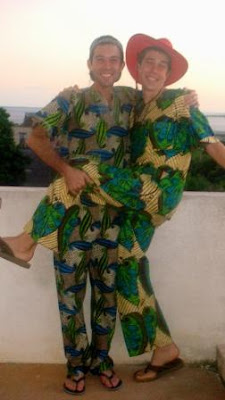


Photo by Ausi PetreliusTo fully express with authority the wonders of the capulana, I would like to borrow some words from the heart of a Mozambican writer, Paulina Chiziane, who recently featured an article about capulanas in the nation's most prestegious magazine. Of the capulana, she writes:
"It accompanies all the stages of our life. With it, we recieve the new-born infant; with it, we make attire for all ages; it is shroud, sheet, headscarf, and blanket. With it, we tie the baby to our back, or make a bundle of vegetables, or tie up a bunch of firewood. It's the practical funcion which gives this strip of cloth is very peculiar character. The capulana is the symbol of Mozambican women, of African women. A real Mozambican woman must have a capulana. Two capulanas. A thousand capulanas or more--the number doesn't matter. One capulana is never the same as another. There can never be too many."
I couldn't agree more, Paulina! There can never be too many! We've certainly tried our best to obey this Mozambican cultural norm. Our enthusiasm for capulanas is widespread. One day I was walking down the street and some young woman I don't even know ran up to me and burst out "Teacher! the new women's day capulanas are being sold down the street!" How did she know that I would be interested? That's easy. Everyone knows the Americanas love capulanas and they love that we love them.
Although we usually aren't seen using capulanas to carry bundles of firewood on our head (we don't have the skills for that) or strap a baby to our backs (we don't have the babies for that), we do find them incredibly useful. They make great blankets, towels, curtains, cushions on long chapa rides, embelishments, and of course, clothing. When we're talking clothing, however, I must admit, that I've never gotten too into the traditional way to wear the capulana-wrapped around the waist like these ladies.
Mine ends up coming un-done and/or I feel incredibly restricted. A girl can't take Americana-sized strides when wearing a capulana like that! (Maybe that's why everyone here walks at just slower than a snail's pace) So we turn our capulanas into capulana clothes, which is also a loved tradition, especially typical of Northern Mozambique.
Life in the Peace Corps gets difficult and sometimes boring. Some volunteers relieve stress by traveling, some journaling, some exercising, and many by drinking the national brew, 2M. But others, like ourselves, occupy some of our time developing fabulous capulana fashion creations.
STEP 1--> Buy a capulana.
Capulanas are typically 1.5m in length and come in pairs. They cost about 150-300 mzm or $4-8 depending on the quality, novelty, printing process, and origins. We walk to the market to buy them. I usually look for the softest and most colorful. They can have extremely modest to ridiculously flamboant prints. They often feature famous people's faces like presidents, the iconic Mozambican heroine Josina Machel, the pope, and even Obama has a capulana dedicated to him in Malawi. They also frequently feature completely random prints like computers, hands, cards, matches, turkeys, tree-stumps, or casserol--anything goes. So anyways, we bargain with our favorite dealers, then add them to our collection.
STEP 2--> Design the clothes.
 With the purchase of a new capulana comes inspiration. We draw designs of clothing on note cards, rip pages out of magazines, or take pictures of people on the street.
STEP 3--> Go to the tailor.
 This is always the hardest part. We have roughly 6 tailors that we frequent with our capulana needs. Each of them has his forte and quirks. It took them a while to get used to our American tastes--like not wanting to make every dress a little baggier in front to allow for frequent pregnancy--but they're more accostomed to us now. We carefully explain the drawing, get measured, and turn in the capulana.STEP 4 --> Pick up new capulana gear.
Finally, after anywhere from a day to 3 months depending on how Mozambican the tailor chooses to be about time-frames, we pick up the clothes. Usually adjustments need to be made, and sometimes the piece is just a big flop. But when it's not...
STEP 5--> Work it!


Tuesday, August 17, 2010
English
Sometimes--trust me, not too often--I wish I was an English teacher here so I could recieve more great txts like the following:
Hello my dear, how are you? I'm not well, i have stomach-ache.your student Pineapple
Hello my dear, how are you? I'm not well, i have stomach-ache.your student Pineapple
Subscribe to:
Posts (Atom)